

There is a lovely moment when the Moon stops looking like a bright circle and starts looking like a place. You notice shadows and edges, and suddenly you want someone else to come over and see.
That is a good goal for a first telescope. Choose a setup you can comfortably carry, aim and enjoy, then let each clear night teach you something new.
Start with the evening you want
| Your priority | Start by comparing |
|---|---|
| A telescope to grow with | Heritage 130 and Heritage 150 |
| Something portable for trips | Travel Scope 80 or Travel Scope 70 |
| Help finding targets | StarSense Explorer LT 80AZ |
| A modest first step | FirstScope Moon or EACONN 70/400 |
| A wider view of star fields | Cometron 7×50 binoculars |
Find your starting point by budget
Choose your shopping currency below. These are separate U.S. and Canadian budgets, not currency conversions. Each amount is a ceiling: lower-cost choices also fit a larger budget. Allow for tax, delivery and any support or accessories you need.
Budget groups are based on the offers noted when this guide was prepared in October 2026. Prices can change. Follow the Amazon.com or Amazon.ca button in each review to check the current price, options and delivery charges before buying.
Shop by budget — USD / Amazon.com
- Under USD $100
- EACONN 70/400
- Under USD $200
- Celestron Travel Scope 80
- Under USD $300
- Sky-Watcher Heritage 130
- Under USD $400
- Sky-Watcher Heritage 150
Shop by budget — CAD / Amazon.ca
- Under CAD $100
- EACONN 70/400; SOLOMARK 80900
- Under CAD $200
- Celestron Travel Scope 70
- Under CAD $300
- Celestron Travel Scope 80; MEEZAA 90/800
- Under CAD $400
- Celestron StarSense Explorer LT 80AZ
The links above lead to each review, where you can compare the setup, limitations and available marketplace buttons. FirstScope Moon and Cometron binoculars are also included below without a budget category.
Find the setup that fits
Our selections draw on manufacturer specifications and product listings. We have not personally tested these models. Each comparison explains what the design offers and what to consider for your own setup.
A rewarding first telescope
Sky-Watcher Heritage 130
For curious beginners who want room to grow. A 130mm parabolic mirror, collapsible tube and simple manual base make this a useful starting point for learning the sky. Begin with the supplied eyepieces, practise finding the Moon, then explore more as your confidence grows.
We may earn a commission from purchases through these links.
More aperture for your next discovery
Sky-Watcher Heritage 150
For a growing interest in astronomy. The 150mm parabolic mirror gathers more light than the 130mm model, while the collapsible tabletop format keeps storage manageable. A thoughtful choice when astronomy is the main purpose and you are happy to learn manual aiming.
We may earn a commission from purchases through these links.
Pack it for the next trip
Celestron Travel Scope 80
For scenery, travel and casual sky viewing. This 80mm refractor comes with a tripod, backpack and smartphone adapter. The supplied 20mm and 10mm eyepieces give 20× and 40×: a friendly starting range for finding the Moon and enjoying wider views.
We may earn a commission from purchases through these links.
A compact introduction
Celestron Travel Scope 70
For a smaller travel budget. A portable 70mm refractor with a backpack and tripod, ready for a mix of daytime scenery and casual night-sky exploration. Compare its current price with the 80mm version to choose the best fit for your budget.
We may earn a commission from purchases through these links.
Make the Moon your first stop
Celestron FirstScope Moon
For a simple tabletop introduction. The Signature Series Moon FirstScope pairs a compact tabletop telescope with a Moon-map wrap. It is an inviting way to begin learning the controls and sharing a first lunar view with an adult’s help.
We may earn a commission from purchases through these links.
Let your phone help you find the way
Celestron StarSense Explorer LT 80AZ
For beginners who want help locating targets. This 80mm refractor uses a compatible smartphone to guide your aiming. Its 900mm focal length and included tripod offer a different setup from the short travel scopes. You still move the telescope yourself.
We may earn a commission from purchases through these links.
Compare a lower-cost starter
EACONN 70mm / 400mm
For first looks at the Moon and scenery. The listed 20mm and 12.5mm eyepieces provide 20× and 32×. This small refractor is an option to compare when you want a modest introduction with a phone adapter and tripod.
We may earn a commission from purchases through these links.
A longer refractor to compare
SOLOMARK 80900
For a tripod setup with room at home. The Canadian listing describes an 80mm aperture, 900mm focal length and 20mm/10mm eyepieces, giving 45× and 90×. Its specifications make it worth comparing when the current offer suits your budget.
We may earn a commission from purchases through these links.
A larger refractor to compare
MEEZAA 90mm / 800mm
For shoppers considering more aperture. The Canadian listing describes a 90mm refractor with a steel tripod and 25mm/10mm eyepieces. Those eyepieces provide 32× and 80× without the included Barlow lens.
We may earn a commission from purchases through these links.
A wider view of the sky
Celestron Cometron 7×50 binoculars
For star fields and a simple starting point. Binoculars are a useful way to explore wider areas of the sky and become familiar with star patterns. These 7×50 binoculars are an alternative to a telescope, with a different kind of view.
We may earn a commission from purchases through these links.
What will the view be like?
Begin with the Moon. Around its first or last quarter, shadows along the boundary between light and dark bring out wonderful detail. With suitable equipment and conditions, Jupiter’s moons and Saturn’s rings can become rewarding next targets.
Live views are smaller and subtler than processed space photographs. Take your time at the eyepiece: focus carefully, let the telescope settle, and notice what becomes clearer as you keep looking.
Your first-night checklist
- Practise before dark. Learn assembly and focusing while keeping the telescope safely away from the Sun. Never aim these instruments at the Sun.
- Make the setup steady. Choose firm ground or a stable tabletop support, with a comfortable viewing height.
- Begin at low power. Start with the longer-focal-length eyepiece to make finding your target easier.
- Choose one rewarding target. The Moon is a lovely place to start.
- Get comfortable. Bring warm layers, a chair and a warm drink in a secure container.
- Share the view. Take turns, ask what everyone notices and leave a little curiosity for next time.
For the whole evening’s plan, open our first stargazing night guide and download its free checklist. For red lights, star wheels and other useful tools, explore the family stargazing gear guide.
Giving a telescope as a gift?
Match the gift to the person’s space and interests. Think about where they will set it up, whether phone guidance would help, and who will help a younger observer. Check the kit before wrapping it, keep the accessories together, and include an invitation to share the first clear night.
From Rooted Future
Wear a little of that wonder
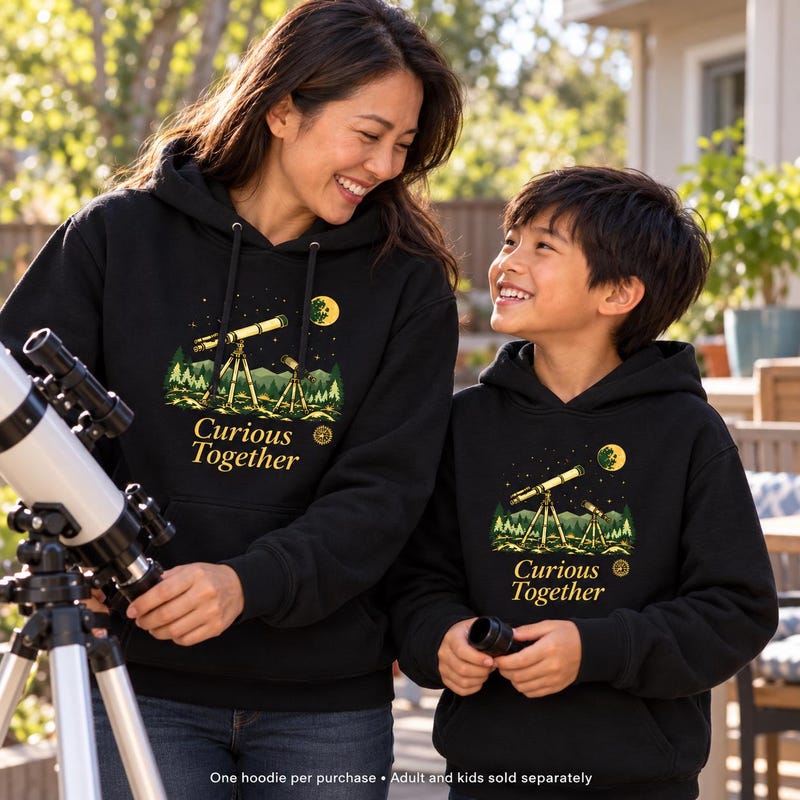
For an astronomy gift that celebrates shared curiosity, explore our Curious Together stargazing T-shirts and hoodies for adults and kids, alongside our telescope hoodies without the slogan. The Two Telescope Stargazing Mug, 11 oz, brings that same wonder to a cocoa break.
Original Rooted Future artwork created with AI assistance.
Apparel and mugs sold individually. Made to order and printed close to you whenever possible. Free standard shipping to Canada and the U.S. on these stargazing designs. See your estimated delivery date at checkout.
Explore stargazing clothingA few helpful answers
Do I need extra eyepieces straight away?
Begin with the supplied kit and discover your favourite targets. You can choose an additional eyepiece later with a clearer idea of what you need.
Does StarSense move the telescope?
The LT 80AZ uses your compatible phone to help you aim. You move the telescope by hand.
How do I choose a telescope for a child?
Think about adult help, viewing height and how easily you can set it up together. A manageable telescope used often can be more rewarding than a complicated one that stays indoors.
Sources and how we chose these options
We compare documented aperture, design, mount, portability and included accessories. Some lower-cost alternatives are based on their individual Amazon listings; comparative build quality has not been independently tested. Prices and availability can change.