
Updated October 2, 2026. Gear is optional. Product examples below were researched, not personally tested by Rooted Future.
Hey, the best first stargazing night is usually the simple one. Pick a safe spot close to home, bring something warm to sit on, and give everyone time to look up. You do not need a telescope, a perfect dark-sky location, or a list of constellations to memorize. If the Moon is out, wonderful. If clouds roll in, you can still have a cozy evening and try again another night.
Here’s the easy plan I’d share with a neighbor who wants the first outing to feel fun instead of complicated.
Before you head out
Choose a safe, easy spot
For night one, start somewhere familiar: your yard, a balcony with a clear view, or a nearby public place that allows evening visits. Look for an open patch of sky and a level place to sit. A spot away from bright street and building lights can show more stars, but you do not have to drive somewhere remote to begin.
Go with an adult, keep children close, follow local access rules, and let someone know where you are going. Bring a charged phone for emergencies, but keep its bright screen tucked away once you are settled.
Check the clouds, then dress for the real temperature
Clouds can hide the show, so check your local forecast before you promise the kids a big night out. Have a backup evening in mind. And bring one more warm layer than you think you’ll need: sitting still under an open sky can feel chilly, even when the day was mild.
Give your eyes a little time
Bright lights make faint stars harder to see. Once you are settled, avoid checking a bright phone screen and give your eyes about 15 to 20 minutes to adjust. If you need a light to move around safely, a dim red flashlight is gentler on night vision. Safety comes first—use whatever light you need to walk safely, and point it down rather than into someone’s eyes.
Neighbor tip: If you want to use a sky-map app, set your location and check it indoors before you go out. Then dim the screen all the way or put the phone away between quick peeks.
Your easy first-night plan: about 30 minutes
1. Get cozy. Spread out a blanket or pull up chairs. Let everyone get comfortable and take a quiet minute to look around. You can start before the sky is perfectly dark.
2. Say hello to the Moon, if it’s up. Look at its shape. Is it a thin curve or a bright round face? You can enjoy it with your eyes alone. If you already own binoculars, an adult can help everyone take turns looking—never point binoculars or a telescope anywhere near the Sun.
3. Pick one bright thing. Choose a bright star, an easy-to-spot pattern, or a planet visible from your location that night. A free star map or astronomy app can help you identify what you are seeing. The sky changes with your location, season, and time, so set the map for where you are.
4. Let the kids be the guides. Ask, “What shape do you see?” or “Which star would you visit first?” Let everyone draw or describe one thing. You do not have to correct every guess; curiosity is the point.
5. Call it while it’s still fun. If someone gets cold or tired, head in. A short first outing that ends on a happy note makes it easier to plan the next one.
The simple stargazing checklist
- Warm layers for everyone, plus one extra layer
- Blanket, camping chairs, or a comfortable pad to sit or recline on
- Water or a warm drink in a closed, spill-safe container
- Notebook and pencil for drawings or questions
- A flashlight for safe movement; a dim red light can help preserve night vision
- Optional: binoculars you already own, a location-matched paper star wheel, or a sky-viewing app checked before you go
- A charged phone for emergencies; keep the screen dim and use it briefly
- A backup date in case of clouds
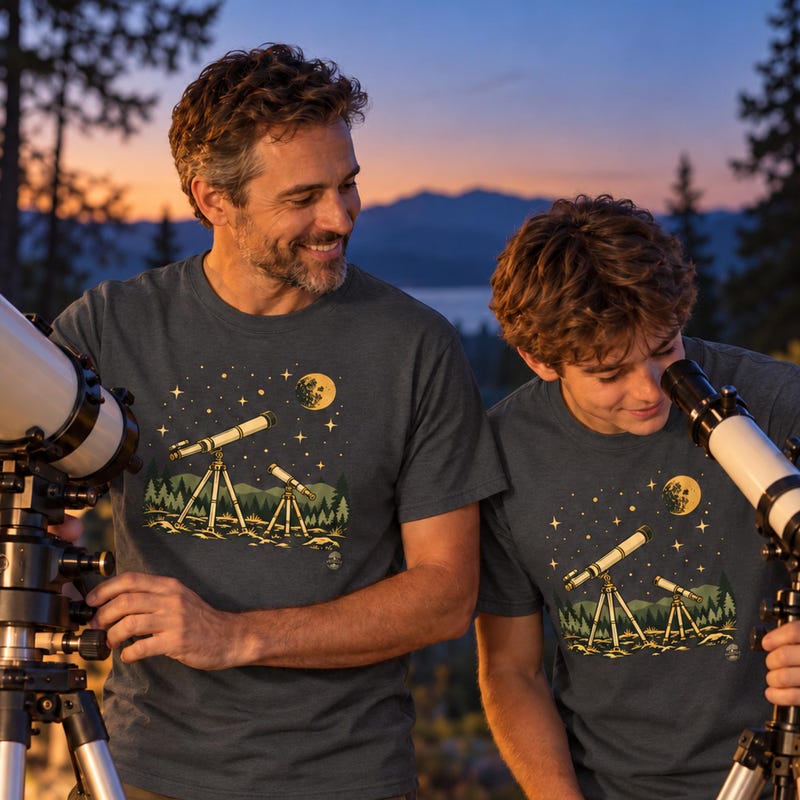
You can leave the telescope at home. Your eyes are a terrific first tool, and a first night is a chance to discover what your family enjoys before spending money. If you later want optics, see whether a library, astronomy club, or public star party near you lends equipment or lets beginners try it.
A few little things that make the night better
- Keep the goal tiny. Seeing one thing together is a win. You do not have to identify the whole sky.
- Face away from nearby lights when you can. Even turning your blanket or chairs can make a difference.
- Skip bright white lights when possible. Use a dim red light for quick tasks, but use a brighter light whenever safety requires it.
- Don’t promise a meteor shower or a planet. What is visible depends on where you are and the date. Check a current sky map before you go.
- Make the Moon your backup plan. A bright Moon can wash out fainter stars, but it still gives you something lovely to notice and talk about.
- Let questions hang in the air. “I’m not sure—let’s find out tomorrow” is a perfectly good answer under the stars.