

A blanket, a clear patch of sky and a little curiosity can make a lovely evening. But if your family wants to see more, the right equipment can make the next outing easier. Start with what would help your family enjoy the next outing. You can always add more later.
Think about what you would like to do next: recognize a few star patterns, share a closer view, or get comfortable looking through a telescope. The options below have separate Canadian and US shopping links.
What should you buy first?
| Your priority | Start here | What to know |
|---|---|---|
| Learn star patterns | A location-appropriate star wheel | Choose by observing latitude, not your shopping country |
| Read a chart with your hands free | A headlamp with red light | Learn the controls indoors; use the lowest useful brightness |
| Share wider views of the sky | Celestron Cometron 7×50 binoculars | An adult should help with grip, fit and focusing |
| Use one pair for nature walks and occasional sky watching | Celestron Nature DX 8×42 | A versatile alternative to a dedicated astronomy purchase |
| Try a small tabletop telescope | Celestron FirstScope | Needs a firm surface at a comfortable viewing height |
| Get help finding telescope targets | StarSense Explorer LT 80AZ | Requires a compatible phone; you still move the telescope yourself |
Choose the tools that fit your next outing: a closer view, an easier way to find your bearings, or a little extra comfort.
1. Binoculars: closer views without a telescope setup
Celestron Cometron 7×50 — our starting option for sky-focused outings
The Cometron combines 7× magnification with 50 mm objective lenses. Its wide view can make it easier to settle in and explore the night sky together.
Choose it if: you want a shared pair for relaxed sky watching. Sit down and support your elbows to steady the view.
Consider the trade-off: these are adult-sized binoculars. Check that each user can align both eyepieces comfortably; helping a child hold them does not guarantee a suitable fit. They are water-resistant, not waterproof.
We may earn a commission from purchases through these links.
Celestron Nature DX 8×42 — for nature walks as well as the night sky
If you would also use binoculars for birds or scenery on family walks, take a look at the Nature DX. Its waterproof construction and 8×42 format make it a more flexible outdoor pair. It can also give you occasional wide views of brighter sights in the night sky.
Choose it if: you would enjoy using the same pair on nature walks and sky-watching nights.
Consider the trade-off: it may cost more than you want to spend on a first try at stargazing. Compare the current prices before deciding.
We may earn a commission from purchases through these links.
A smaller option for daytime exploring
The National Geographic 6×21 children's binoculars are easier for small hands to use when exploring outdoors during the day. Their small lenses gather less light, so they are a weaker choice for a dim night sky. They make more sense as a child’s daytime pair than as your main stargazing binoculars.
We may earn a commission from purchases through these links.
With any binoculars or telescope, supervise children and never look at the Sun through the instrument.
2. Lighting: see your chart without lighting up the gathering
Nitecore NU25 MCT — a rechargeable, multipurpose option
This headlamp offers white lighting and auxiliary red light, with USB-C charging. It may be handy if you also need a light for walking or camping.
Before you head out, practise switching it to red light. Use the lowest useful setting and aim it down. Even red light can be distracting when it is bright or pointed into someone’s eyes.
Choose it if: you want one headlamp for several outdoor tasks and are comfortable learning its controls.
We may earn a commission from purchases through these links.
Celestron Night Vision Red Headlamp — a dedicated US alternative
A red-only headlamp is an alternative if you prefer a dedicated observing light without a white-light mode. It serves a different purpose from a general walking light, so still bring suitable lighting for getting safely to and from your viewing spot.
We may earn a commission from purchases through these links.
Which would we choose? Compare the Nitecore for broader usefulness and the Celestron for a dedicated red-light role. Safe footing always matters more than preserving dark adaptation.
3. Star wheels: choose the right latitude
A planisphere is a rotating paper or plastic sky map. Align its date and time to help identify the star patterns above you. It gives everyone something to explore together without repeatedly reaching for a bright phone.
The important number is the latitude where you will observe. You might need the same edition as a family across the border, or a different one if you are travelling much farther north or south.
We may earn a commission from purchases through these links.
| Option to compare | Shopping links |
|---|---|
| Planisphere, Latitude 50°N | View on Amazon.ca |
| The Night Sky 40°-50° (Large) Star Finder | View on Amazon.com |
| Firefly Planisphere, Latitude 42°N | View on Amazon.ca · View on Amazon.com |
The US-linked Night Sky star finder is the large 40°–50° edition; the Canadian-linked 50°N planisphere is a different option. Choose for where you will watch the sky, rather than the country you shop in. Check each edition’s stated geographic coverage before ordering. If these options do not cover your location, use a location-set sky map while you find a suitable edition.
4. Telescopes: two different ways to take the next step
Celestron FirstScope — a compact tabletop introduction
The FirstScope is a small 76 mm reflector on a tabletop base. It is an option for families who want to try a simple, manually aimed telescope without starting with a full-height tripod setup.
Choose it if: you have a firm table or other stable support at the right height, and an adult is happy to help aim and focus.
Consider the trade-off: the supporting surface is part of your setup. A wobbly camping table can make observing frustrating. Keep expectations modest; this is an introductory instrument, not a route to the colourful detail seen in processed astronomy photographs.
We may earn a commission from purchases through these links.
Celestron StarSense Explorer LT 80AZ — help finding your way
This 80 mm refractor uses a compatible smartphone and the StarSense Explorer app to help you locate targets. The app helps you find where to point, but you still move the telescope yourself.
Choose it if: finding objects is the part you want help with, and an adult can handle phone setup and alignment.
Consider the trade-off: check phone compatibility, the exact package contents and your space for the tripod before purchasing. Give yourself time to practise aiming and focusing, even with the app.
We may earn a commission from purchases through these links.
Our practical choice: choose the FirstScope for a small tabletop introduction; consider the LT 80AZ when phone-assisted finding is worth the additional setup and current price difference to you. You do not need both.
Pack the comfort items you already own
Bring warm layers, comfortable seating, water and a notebook. Choose an accessible place with safe footing, check the forecast and keep the first session short enough that everyone wants another one.
Set up any new equipment before dark. Try the focus wheel and headlamp buttons at home so you can spend more of the evening looking up.
Common questions
Do children need their own telescope?
No. A shared instrument with an adult helping can be a better starting point. Comfort, eyepiece height and patience matter more than giving everyone their own equipment.
Is higher binocular magnification always better?
No. Magnification also makes hand movement more noticeable. For a relaxed shared outing, a view you can hold steadily is more useful than a bigger number on the box.
How can we keep the cost down?
Begin with what you own. If buying, choose the item that solves your actual problem: a chart for finding patterns, a suitable light for reading it, or binoculars for closer views. Compare the delivered total and seller terms rather than assuming every deal is good value.
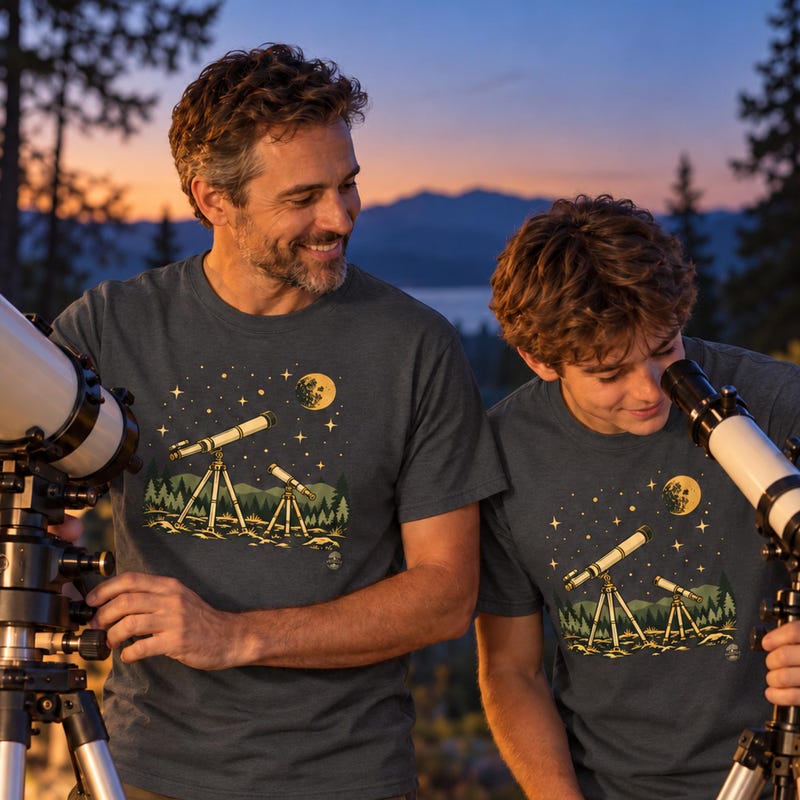
Bring a little curiosity into the everyday
Our Curious Together Telescope T-Shirt celebrates the fun of looking up together. If you know someone who would love it, Etsy has the sizes and delivery details.
For more ways to carry that curiosity into everyday life, explore our adult and kids stargazing T-shirts and hoodies, or our Two Telescope Stargazing Mug, 11 oz. Each garment and mug is sold separately.
The sky is still yours to enjoy without a shopping list. Choose what makes your next outing easier, and leave room for the best part: noticing something together.
Keep exploring
Your First Stargazing Night with Kids — a simple plan for turning these ideas into an evening outside.